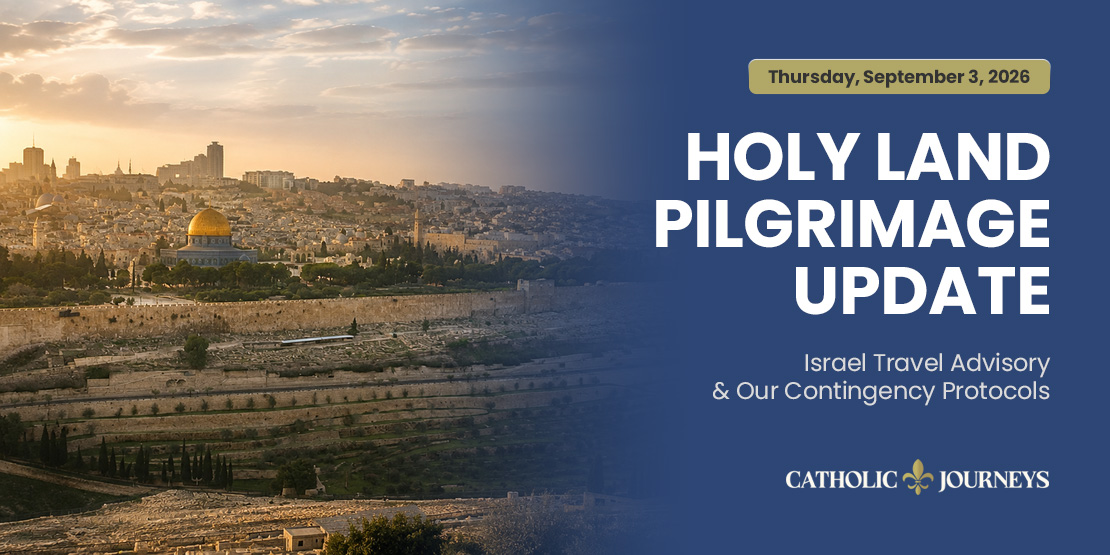
Last updated: September 3, 2026. Conditions and travel advisories can change — always confirm current guidance with official sources before traveling.
Dear Fellow Pilgrims,
As we begin resuming pilgrimages to the Holy Land in October 2026, we realize many of you are prayerfully discerning whether to travel as planned with the group, or to postpone your participation for a later time. After multiple conversations with our partners in Jerusalem and after speaking with clergy who just recently returned from the Holy Land, we have decided to share this information with you in an effort to help you feel better informed and more comfortable with whatever decision you make.
Ultimately, the decision to travel rests with the individual pilgrims. We are a logistics company that specializes in pilgrimages, not a crisis management company. Our role is to provide transparent risk assessment and robust contingency plans, which include full credit if a trip is cancelled by airlines, governments, or by our own prudent reevaluation of safety. The company’s posture is clear: Safety is our top priority and we will not send pilgrims into a full-blown war, but we will operate within the managed-risk environment that currently exists, backed by proven contingency protocols.
We are sharing what we know about the situation on the ground in and around the cities and Holy Sites we visit, our analysis and steps we have taken to mitigate any interruptions or areas of potential risk in our itineraries, and we are sharing our contingency protocols with you in the event of an emergency.
1. Decoding the Travel Advisory
The Nuance: The discussion clarifies the distinction between different U.S. State Department advisory levels. The current advisory for the region is Level 3 (“Reconsider Travel”), which is a step below the absolute Level 4 (“Do Not Travel”).
The Context: This Level 3 advisory has been in place since the terrorist attack on October 7, 2023 and has not been downgraded. While it warrants caution, it is not a complete prohibition, and the areas on the itinerary are not specifically designated as “avoid” zones.
2. Operational Safeguards & Itinerary Adjustments
Catholic Journeys has proactively modified its operational plan to enhance safety and logistical stability:
- Direct Flights Only: All travel will be on direct flights from the U.S. to Tel Aviv and back, avoiding layovers in other foreign countries.
- Accommodation Strategy: Pilgrims will be lodged in Jerusalem instead of Bethlehem. While Bethlehem is not inherently unsafe, its location on the other side of the wall presents a risk of being cut off if authorities decide to periodically restrict access.
- Defense Systems: Confidence is placed in Israel’s “Iron Dome” defense system to mitigate rocket threats, which are noted as not currently targeting Israel directly.
3. Contingency Protocols & Financial Guarantees
The company has a clear protocol for various “what-if” scenarios, emphasizing pilgrim choice and financial protection.
- Client Discretion: The final decision to travel always belongs to the pilgrim. They can opt out if they feel uncomfortable, even if the tour proceeds.
- External Cancellations: If an airline (e.g., United, Delta) cancels flights, any credits received from the airline will be passed directly to the pilgrim.
- Firm-Initiated Cancellations: If the company determines conditions have become unsafe, it will proactively pull back. In this event, pilgrims are guaranteed the full value of their investment as a full credit for a future trip (e.g., postponing a year, or switching to another destination like Italy).
- On-the-Ground Emergencies: The company has proven contingency plans for extracting groups if a situation deteriorates suddenly, citing a past event where a group was successfully evacuated to Jordan and flown home from Amman.
4. A Critical Lesson in Operational Security
A past incident involving another tour operator at the start of the Iran conflict in February 2026 serves as a stark reminder of what not to do. That company posted the specific hotel locations of their American pilgrim groups on social media, creating a potential security risk. Catholic Journeys’ protocol is to communicate directly and privately with emergency contacts and families, not to broadcast sensitive information publicly. The company’s policy is to maintain strict information security, only stating publicly that it is aware of the situation and working to ensure its pilgrims’ safety.
The following is provided to help manage pilgrims’ anxiety around travel to Israel.
At-a-Glance
Israel Pilgrimage: Risk Assessment & Operational Strategy
Balancing travel advisories, logistical safeguards, and pilgrim protections in a managed-risk environment.
Managed Risk Assessment
“We are a logistics company that specializes in pilgrimages, not a crisis management firm.”
U.S. State Department Advisory Level 3
The status remains “Reconsider Travel” (Level 3), not “Do Not Travel” (Level 4). This advisory has been static since October 2023.
Financial Guarantees
Protection Policy
100% Investment Value
Full credit if the company cancels due to safety concerns or airline disruptions.
- Client retains final decision to travel
- Credits transferable to other destinations
Logistical Safeguards
Operational Security Protocol
Information Integrity Rule
Never broadcast group locations or hotel names on social media while the group is traveling. Communication is restricted to private emergency channels.
Emergency Readiness
- Proven extraction protocols.
- Prudent re-evaluation: proactive pull-back if conditions deteriorate.
- Direct families-only incident reporting policy.
Crisis Response Context: Safety assessments updated based on airline operational status and State Dept. bulletins.
We invite you to contact our office if you have any questions, or if we can be of any further assistance in helping you in your decision-making process, and as always we ask you to join us in prayer for the people of the Holy Land, all pilgrims and for lasting Peace.
Sincerely in Christ,
James “Jimmy” Hyland
Catholic Journeys